

America can be a place that attracts people because of the diversity of what it has to offer in every way possible: sparkling high-rises, vast national parks that could be considered even as a small country, laid-back beach towns, desert roads, and non-stop cities. Everything appears to be the whole world on its own, each area having its unique accent, cuisine, and style of living. But being such a vast and diverse country, America is so overwhelming for the person visiting for the first time that he needs to decide where to begin even before his journey starts. This USA travel guide was compiled for you to help plan and organize your vacation in America.
When you think of Route 66, the Grand Canyon, or even spending the weekend in New York, preparation is key. Here's a breakdown of all you need to know about your trip to visit America.
When to Visit America
Timing your trip can make or break the experience. The United States spans multiple climate zones, so the best time to visit America really depends on where you're headed.
- Spring (March to May) - Mild weather across most regions, blooming cherry blossoms in Washington D.C., and fewer crowds than summer.
- Summer (June to August) - Peak travel season. Great for national parks and coastal cities, but expect higher prices and bigger crowds.
- Fall (September to November) - Arguably the most beautiful season, especially in New England, thanks to colorful foliage and comfortable temperatures.
- Winter (December to February) - Ideal for ski trips out West or holiday shopping in major cities, though northern states get seriously cold.
When you're mapping out your own itinerary, plan around the region first, then the season. Florida in July feels nothing like Colorado in July.
Entry Requirements and Visas
Don't consider packing until your entry requirements are sorted. Visitors who come from Visa Waiver Program countries can apply for an ESTA (Electronic System for Travel Authorization) online and obtain authorization for 90 days of stay for tourism or business purposes. If your passport does not belong to one of these countries, then you should apply for a tourist visa B1/B2.
A few tips:
- Apply early, since visa appointments can be booked out for weeks or months.
- Keep your passport valid for at least six months beyond your travel dates.
- Have proof of onward travel and sufficient funds ready in case immigration officers ask.
- Fill out your customs declaration form accurately, since undeclared items can lead to fines or delays.
- Print or save digital copies of your travel authorization, hotel bookings, and return flight details before you land, as border officers sometimes ask to see them.
Requirements for entry may vary, so it would be best to check the official U.S. Customs and Border Protection website closer to your departure date, rather than getting outdated information from friends or forums.
Getting Around the Country
The United States is vast, and there is no efficient network of public transport between cities, as compared to Europe and Asia. This is how most tourists travel:
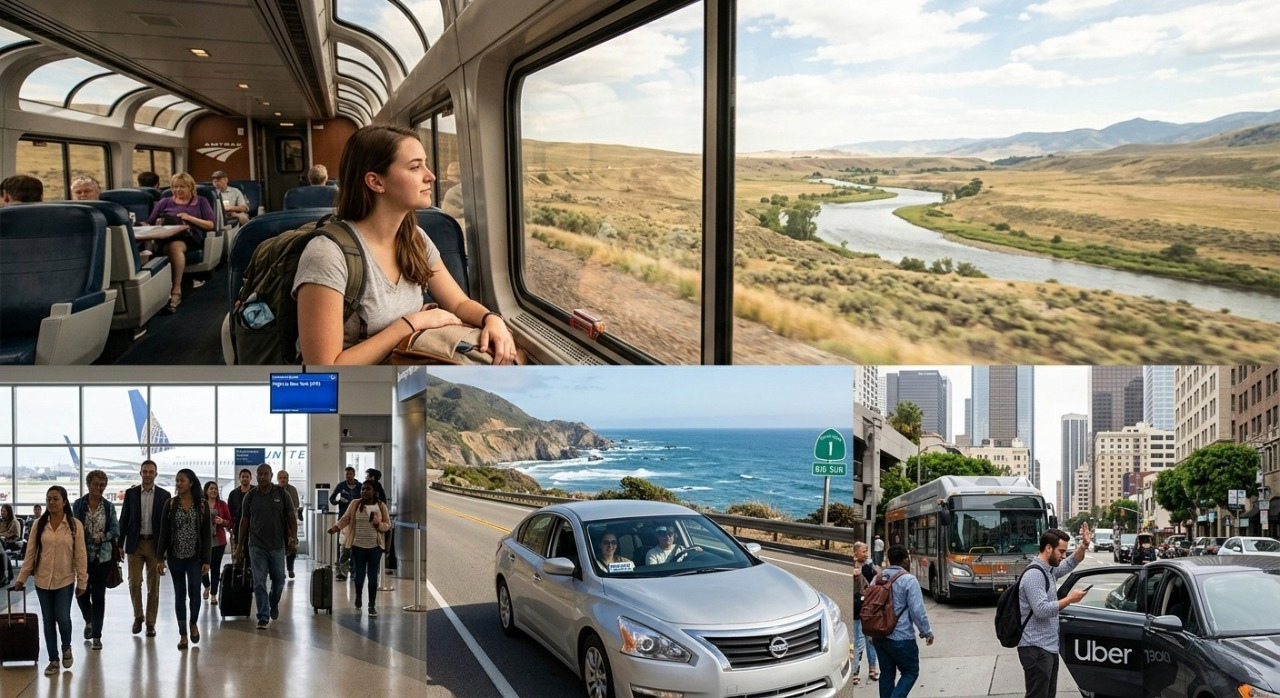
- Domestic flights are the fastest way to cover long distances, especially coast to coast.
- Rental cars give you the freedom to explore road trip classics like the Pacific Coast Highway or the Blue Ridge Parkway.
- Amtrak trains connect many major cities, though schedules can be limited outside the Northeast Corridor.
- Rideshare apps (Uber, Lyft) and city transit systems work well for getting around within urban areas.
However, when planning a road trip, be sure to secure the use of your rental vehicle in advance because rates skyrocket in the busy travel season. Moreover, it will be useful to measure the driving distance in advance because sometimes a short trip on the map may actually take eight hours of driving in America.
Where to Stay
Hotel rates may differ significantly between different cities depending on whether you are staying at budget hotels or expensive resorts. In general, small-town hotels and Midwestern cities offer relatively low prices compared to New York, San Francisco, and Los Angeles. Hotel bookings, especially in national parks and beach resorts in the summertime, are the easiest way to save money.
Moreover, it is also recommended that one should compare different accommodations, such as hotels, extended stay accommodations, and vacation rentals, before making any decision. Depending upon the circumstances, it is likely that extended stay accommodation is less costly than other alternatives, and cost savings in local transportation can also be substantial if one is staying close to the transportation center.
Budgeting for Your Trip
Money matters shape most trip decisions, so plan realistically:
- Meals: Expect $15 to $25 for a casual restaurant meal, more in major cities.
- Transportation: Domestic flights and car rentals vary widely by season and route.
- Tipping: Tipping is customary in the U.S., typically 15 to 20% at restaurants, plus small tips for hotel staff, drivers, and bartenders.
- Currency: The U.S. dollar is used everywhere; credit cards are widely accepted, though it's smart to carry some cash for small purchases.
Must-Visit Destinations
No trip to America is complete without hitting a few iconic stops. A well-rounded itinerary might include:
- New York City for its skyline, museums, and unmatched energy
- The Grand Canyon for one of the most awe-inspiring natural landmarks on Earth
- Los Angeles and Hollywood for beaches, entertainment, and sunshine
- Yellowstone National Park for geysers, wildlife, and hiking trails
- New Orleans for jazz, food, and rich cultural history
- Miami for vibrant nightlife and stunning coastline
Consider selecting 2-3 regions rather than visiting an entire nation at once. Covering the entire nation in a trip can be as surprisingly lengthy as the distances covered are large, as moving from point A to point B is quick in vacation time.
USA Travel Tips for Visiting America
- Pack for variety. Weather can shift dramatically depending on the region and season.
- Get travel insurance. Healthcare in the U.S. can be expensive without coverage, so protecting yourself against emergencies is essential.
- Stay connected. An eSIM or local SIM card makes navigation, translation, and communication far easier during your trip.
- Learn tipping culture. It's expected in restaurants, taxis, and hotels, and skipping it is considered impolite.
- Book key experiences early. Popular attractions, national park permits, and event tickets often sell out well in advance.
These simple USA travel tips can save you time, money, and a lot of last-minute stress once you land.
Final Thoughts
Traveling to the USA is like traveling to multiple countries within one country, and that's exactly why it is such a great experience. From applying for ESTA to deciding whether you want to drive around or fly, a little planning beforehand transforms your complex trip into an unforgettable journey. Hopefully, this USA travel guide will provide you with all the necessary information, but the real deal begins when you start comparing flights and hotels for your particular dates.
That's where tabha.net comes in. Tabha lets you compare flights, hotels, car rentals, and more from trusted providers side by side, so you can plan your American adventure without the stress of switching between a dozen browser tabs. Search once, compare everything, and book smarter with Tabha.
FAQs
Q1. Do I need a visa to visit the USA?
Ans. It is dependent on your country of origin. Visa Waiver Program (VWP) countries must submit an online ESTA application for entry for a stay of up to 90 days, and non-VWP countries are required to obtain a B1/B2 tourist visa at a U.S. Embassy or Consulate.
Q2. What is the best time of year to visit America?
Ans. In most areas, the weather is mild in spring and fall, but less crowded. National parks and beaches are open during the summer, and skiing is a great activity in winter, although this varies by region.
Q3. Is it expensive to travel around the USA?
Ans. Fares are highly variable. Big cities such as New York and San Francisco cost more, but there are deals to be had in various small towns, road trips, and off-peak travel dates throughout the country.
Q4. How do I get around the United States?
Ans. Domestic flights are best suited for long distances, and rental cars are best suited for road trips. Amtrak trains link some major cities, and rideshare apps or public transit services can be used to get around most of the cities.
Q5. Is tipping mandatory in America?
Ans. While there is no legal requirement to tip in the U.S., it is expected. In the United States, a 15% tip is usually expected at restaurants, and small tips are customary for any staff member in a hotel, such as the driver or a bartender.
Q6. Do I need travel insurance for a USA trip?
Ans. Yes - it is definitely advised. Travel insurance can be very useful in America when healthcare costs are high without coverage, and can help prevent medical emergencies, trip cancellation, or other unexpected disruptions to travel.